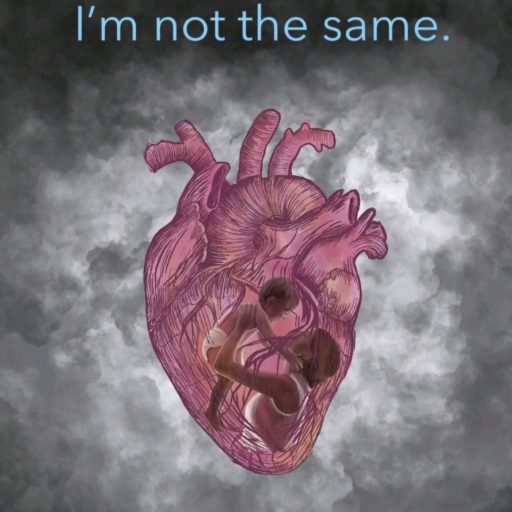

Image Description: A woman in gray/blue tones is sitting on the ground in profile, facing to the left. Over her is a huge wave cresting, ready to crush her.
“Anxiety is love’s greatest killer. It makes others feel as you might when a drowning man holds on to you. You want to save him, but you know he will strangle you with his panic.” (Quotation by Anais Nin (1903 – 1977), The Diary of Anais Nin, volume 4, 1944-1947).
This blog post is collaborative, meaning that I sent the same questions to willing participants who expressed their personal experience with chronic and debilitating anxiety,
Ever since I was a little girl, my chest has been tight. When I learned what a vice grip was, and how it could progressively squeeze pieces of wood tighter, and potentially crush a less solid item, I immediately related.
At four, I would twist and turn in my sheets, traumatized by nightmarish intrusive thoughts that left me feeling deeply “other-ed”. I knew that other children didn’t think about being burned alive in a house fire, for example, so I created my own coping mechanisms. I would reach out in the darkness with my eyes closed and pretend to turn the dials on the old TV like my grandparents’ TV. Sometimes I would use an invisible remote control to “change the channel” away from the fearful thought. Occasionally it worked.
In any case, I knew I couldn’t tell anyone.
So the anxiety stretched and clutched the broken pieces of my insides like a climbing vines, hooking on to themes like getting A’s, winning races, or getting into college.
I am an enigma; both strong as a huge block of granite, but one with meandering cracks that any given knock with a hammer of anxiety could shatter.
A few years ago I met a fellow mom friend who said that she never really ever felt anxious.
Never really felt anxious.
Ever.
My brain did not understand that.
I might have moments, hours, days, or even weeks without anxiety, but this was a fully-formed, 35 year-old woman with a job and children who “just never really felt anxious”.
I have never been more jealous in my life.
I reached out to my community to speak with other women who live with acute, and chronic, anxiety.
I asked them questions that resonate with me when I imagine my own tsunami of anxiety.
Read below to see their answers. Some names are pseudonyms and some are their true first names:
If you express what your anxiety is like in a few sentences, what would you say?
QUEENIE:
“It’s like a freight train at full speed. Sometimes I keep on the tracks, sometimes it derails and destroys entire ecosystems in the struggle to regain control.”
TABATHA:
“My anxiety feels like being mentally and physically short-circuited. My mind races so fast I can’t finish one thought before the next one barges in. I feel bloated and full of stress gas, like my body is physically reacting to the pressure inside me. My heart pounds, I shut down socially, and my memory gets spotty. I feel completely out of control — overwhelmed, frozen, and unable to move forward. Even small tasks feel impossible because I get stuck trying to figure out the “right” next step. It’s not just overthinking — it’s being paralyzed by it.”
DAWN:
“I’d say that it is like a darkness that creeps up on me out of nowhere. It comes over me so quickly sometimes that I don’t have time to catch my breath… and my heart starts beating at at thousand miles an hour – well it feels that way to me. And all this while, I am trying to tell my brain, okay slow down, okay take a breath, okay you can do this, while feeling my hands and legs get numb and just crumbling on the inside, while trying to hold up myself so no one can see. Because what can anyone do at this point?”
SAM:
“Racing thoughts, intrusive thoughts, racing heart, zoning out, flashbacks, not being able to breathe at times, light headedness.”
When did you start experiencing anxiety?
QUEENIE:
“I started to notice anxiety early in elementary school, around 5 or 6. I feel stuck, staring at something I was supposed to do, and not really be able to do anything with it. I would see others playing and having fun but feel complete fear at the thought of trying to join them. I didn’t know to label it or what to call it or how to describe it, but in hindsight that’s what it was.”
TABATHA:
“I didn’t label what I was experiencing as anxiety until I was in college. That’s when I started noticing patterns that mirrored my mom’s — she had generalized anxiety disorder, among other things — and I began to connect the dots between her struggles and mine. But looking back, the signs were there as early as 4th grade. I remember thinking it was funny that I already had a wrinkle between my eyebrows at 16, a sign that I was carrying stress even back then. I always had one “safety person” — a best friend who grounded me. I depended on them completely and felt anxious if I had to do anything without them. I’d dread social interactions with others, and I’d spiral if I thought I had disappointed or upset that person. I didn’t have the language for it at the time — it just felt like I couldn’t function unless I had that anchor.”
DAWN:
“I had always been an anxious child… I experienced anxiety all throughout my childhood, the messy teen years, and right through to adulthood. I don’t think I thought about it as anxiety the way I do now. I was sad, I was scared, I just couldn’t move some days. I just never felt good enough and I had low self-esteem which didn’t help matters. I saw a therapist probably around the age of 14, and initially I was diagnosed as having depression, but I don’t feel the tools that were presented to be then really helped me cope any better with the anxiety and well it wasn’t the right diagnosis to start with… Much later on around the age of 40, I was diagnosed with bipolar disorder and chronic anxiety.”
SAM:
“Ever since I was child but it got worse as I got older particularly when I stopped drinking as I was self medicating beginning at age 15-16.”
Would you say that you are anxious about everything (future tripping, assuming everything goes wrong) or do you have specific themes that you are always anxious about?
QUEENIE:
“My anxiety is tied to OCD. My themes are pretty consistently needing anything I’ve worked on to be just right. It’s related to never being enough or never being good enough. That I’ll be responsible for others hurting or suffering.”
TABATHA:
“My anxiety revolves mainly around social interactions and how I’m perceived. If I don’t feel 100% confident in what I’m doing, I’m afraid to initiate any kind of interaction, even if it’s something simple. I’ve gotten “trapped” in stores because the pressure of the social interaction at checkout overwhelms me. If I can’t find my credit card quickly, I panic, thinking I’ve held everyone up and ruined their day. I also feel like I’m constantly “in the way” of others in the aisles, as if my presence is a disruption. It sucks because I actually love browsing and shopping in person, but the anxiety takes over and turns something I enjoy into a stressful experience. It’s not just that things are going wrong — it’s that I’m hyperaware of myself and my actions in these situations, and I feel like I’m always one wrong move away from causing a problem.”
DAWN:
“I’d say in recent years, I am anxious about specific things. I get anxious about financial struggles, my business not doing well, not performing well in front of an audience or on stage. You have to understand that before my 40s, I was anxious about every single thing, going to the mall, ordering food, going to the market – so I tap myself on the back and say “hey lady you’ve come a long way!” But the anxiety remains, the sadness remains, that void inside me is still there, I am just coping with it better. I am thankful for the tools I have now compared to many years ago… I understand the power of breathing, the power of noticing my thoughts (as just thoughts), at positive self-affirmations, and the power of medication.”
SAM:
“Specific themes; large groups of people, socializing, public speaking, talking on the phone”
If your anxiety started before adulthood, what were some things you were more anxious about than the average child? If this describes you, did you tell anyone? If so, how did they respond?
QUEENIE:
“I was incredibly anxious about doing anything wrong, ever. It could be socially, or on school work, or chores, I was just afraid of making any mistakes.”
TABATHA:
“I think my anxiety is a mix of family history and growing up as a sibling to someone with autism who struggled with communication and severe behaviors. My brother didn’t act like a “typical” sibling, and it often drew unwanted attention when we were out in public. People would stare at us or even tell my parents to “control their child.” My brother had communication delays, which led to meltdowns in stores or restaurants, and he also had a hearing problem, so he was always very loud. Being in those situations made me anxious because I felt like all eyes were on us, and I was hyper-aware of how others were reacting. I’m sure these experiences played a role in shaping my anxiety — being in public spaces felt like a constant reminder that I wasn’t in control of how people viewed us.”
DAWN:
“I was anxious about making phone calls, I was anxious about going to a mall. I was anxious when people would come over and I’d have to go greet them. To this day, I struggle with this, but I now do a lot of prep work before-hand to calm myself. I used to be anxious about exams that I had studied for and would then ace with A+ grades (go figure). I was anxious about not making my parents happy or my friends (chronic people pleaser). The list is endless, if there was something happening, I was anxious about it!”
SAM: “
Family events. [I never told anyone].”
If your anxiety started in adulthood, can you pinpoint what triggered it?
QUEENIE:
“My anxiety started as a kid, but it became magnified when I became a parent.”
TABATHA:
“As an adult, there have been three major experiences that significantly worsened my anxiety. The first was when I was a special education teacher and an issue arose that brought intense scrutiny and pressure. I completely unraveled under the weight of being watched and judged, and I ultimately left the teaching field — I’ve never looked back.
The second was the end of a 13-year relationship. He was my “safety person,” and losing that anchor — especially since I’d never experienced a breakup before — was traumatic and destabilizing. It happened just a year after I left teaching, and the combination of both left me completely unmoored. I can see now that it was a necessary catalyst for personal growth, but it was brutal at the time.
The third is more cumulative: I lost my mom, became the full-time caregiver for my brother, started carrying a lot of emotional weight for my dad, and navigated a marriage where my husband is highly communicative and I am historically under-communicative. That dynamic — paired with grief and caretaking responsibilities — has stretched my emotional bandwidth thin. All of these moments have intensified the social and emotional dimensions of my anxiety in adulthood.”
DAWN:
“My anxiety was present all throughout my life. I think as I grew older and when I got my later diagnosis it helped me make more sense of things. I became more accepting of myself, I learnt that I am not broken or faulty. This awareness helped me cope better in situations that would typically bring on excessive anxiety. It helped me go in search of more ways I could support my own well-being. Medication, meditation, mindfulness – my 3Ms! I am depressed a lot of the times, don’t get me wrong, but it helps to know that there is a reason for that and I’m not just being an ungrateful twat! And it helps to know that my awareness of this is in its own way guiding me to help myself. I don’t fight the anxiety anymore, I listen, I give it space, I cry a whole lot, but I give myself kindness and compassion. On days when I can’t leave my bed, I tell myself that it’s okay, that we all need rest, and I allow myself that space.”
SAM:
“Weight/peer pressure/ socialization.”
What happens when you think someone is mad at you?
QUEENIE:
I feel the need to be as small as possible. I feel the drive to at least look busy, like that would fix it somehow, and out of the way. If I could find a way to physically shrink or become invisible, I would. My heart doesn’t seem to slow down, and my heart rate feels erratic even if it’s not. It comes close to feeling my panic attacks, but just different enough for me to know the difference.”
TABATHA:
“When I think someone is mad at me, especially someone close to me, my mind and body go into total crisis. It feels like I’ve been suddenly slapped across the face by someone I trust — like they’ve just told me I’m a horrible person who never gets anything right, even if they haven’t said those words. That’s how it lands. My face gets hot, my breathing shifts — sometimes I catch myself holding my breath, other times I hyperventilate — and I know I’ve passed the point of logical reasoning. My first instinct is to escape. I’ve wanted to open a car door and fall out. I’ve had to physically sit on my hands to stop myself from slapping my own face or slamming my head into something, just to make everything stop. I often walk away, lock myself in a dark room, sit on the floor, and cry. The darkness helps — maybe because I feel hidden there, unjudged. I wish the room were soundproof. The emotional pain is so overwhelming that I silently beg myself to black out or go numb. Eventually, I do. Not because I’ve calmed down, but because my system has short-circuited. I stop feeling hunger, stop feeling overwhelmed, stop feeling anything. I just become empty. And if the person is still talking, I try to tune them out — not because I don’t care, but because I can’t take in more words that might hurt. It’s full-on survival mode.”
DAWN:
“Gosh whenever I think someone is mad at me, my mind starts racing… I have a million thoughts of why they could be mad at me, what did I do, when did I do it. My chest becomes tight, I can’t look them in the eye – as though I am ashamed. I feel helpless and I can’t think clearly. My head feels like it is about to explode from the overthinking and I get the most terrible headaches during this time. My throat feels like I am being choked somehow, because I become incapable of expressing myself well. And my tummy – don’t even get me started on that, it feels so tight and in knots and it physically bloats up – too much info maybe!”
SAM:
“I actually don’t mind conflict; I think that I go into fight mode and survival mode. I speak better when angry actually”
Are you confrontational or conflict averse? If you have a conflict, how do you handle it? Have you ever cried in an inappropriate setting, like the workplace? Or, if you are able to maintain your composure, what happens after you escape the confrontation?
QUEENIE:
“I fall into both buckets here. It depends on the situation and whether the conflict is over myself or something else. If it’s directly over interpersonal conflict and directly involves me as a person, I stumble my words, I cry uncontrollably, I stutter, I shut down or give up fairly quickly. If it’s about the handling of a situation, or to stand up for someone else, suddenly I’m articulate and direct, with no fear at all and will generally charge headfirst into the conflict.”
TABATHA:
“I am extremely conflict averse. I think it stems from a deep fear of judgment and the belief that if I speak up, I’ll somehow get it “wrong” or be perceived negatively. I’ll often go along with things I don’t agree with or suppress my own needs just to avoid potential conflict. Even if I feel strongly about something, the idea of having to explain myself or defend my perspective feels overwhelming — like it’s not worth the emotional toll.”
DAWN:
“If I do have to go through conflict, my face gets hot and I get very quiet. I know I look terrified or super stressed. My face scrunches up and I get a tension headache from clenching so tightly. Sometimes, I have outbursts of defensiveness or irritation, especially when I hyperfocus on the other person’s word usage and correctness. It matters to me because I want so badly to understand their point of view, but I can’t let go of these little corrections — they prevent me from fully comprehending what they’re saying. I usually manage to hold it together during the conflict itself, but the second I’m alone, I release it all. I’m emotionally drained and I replay the interaction in my head for days, sometimes for years. It becomes really hard to move past it. If the conflict was with someone I care about, it makes it difficult to imagine initiating a neutral or positive interaction with them again. I just want to retreat and disappear.”
SAM:
“Yes I have cried in workplace and other settings that are inappropriate. I don’t shy away from conflict.”
Do you have a formal diagnosis of an anxiety disorder? If so, what is it (OCD, GAD, etc.)? If you do, do you take medications? What type: antipsychotics, antidepressants, hypnotics, mood stabilizers? If you do take medications, do they help?
QUEENIE:
“I have a formal diagnosis of OCD. Antidepressants actually make my symptoms worse, so have mood stabilizers. Xanax I end up taking on an as needed basis, a few times per month, and if I were allowed to take it daily I would because it’s the only thing that has ever left me feeling honestly, fully, symptom free. I can think clearly, there’s no obsessive or intrusive thoughts swirling in my head, no drive towards compulsions, and I can take the world around me in stride. I’m able to be fully me. I experience no side effects at all from it. Instead of getting to feel that consistently, I wait until I’m in a cluster of panic attacks that are interrupting my ability to function before I cave and take it because that’s the only way I can keep it prescribed to me.”
TABATHA:
“Yes, I have a formal diagnosis of social anxiety disorder (SAD), and I was recently diagnosed with binge eating disorder (BED). When I first sought treatment, a different doctor jumped straight to bipolar disorder, and I was heavily medicated — 2mg clonazepam three times a day, some other med, and Lithium. I had never received any diagnosis before (even general anxiety), so when the doctor suggested bipolar disorder, I accepted it, thinking medication might provide some relief. Unfortunately, taking so many heavy medications suddenly turned me into a zombie, and I still didn’t feel the relief I sought. She told me that on average it takes 13 years for someone to get to a bipolar diagnosis, and that my mother most likely had undiagnosed bipolar disorder as well.
Ultimately, a mix of changes in insurance, not scheduling a follow-up, running out of medication, and my friends talking me through it led me to stop pursuing treatment. After a few years, I tested out BetterHelp and worked with a couple of talk therapists, but eventually, I connected with a psychiatrist’s office and started to explore different medications. I took Escitalopram (Lexapro) 20 mg for many years, which had some success. But after bariatric surgery, I grew frustrated with the low libido side effect and switched to Venlafaxine (Effexor), which I increased to 150mg. Around the same time (or shortly after), I developed physical self-harm behaviors, though my psychiatrist didn’t believe the medication caused them. In addition to Venlafaxine, I have the option to take Clonazepam (Klonopin) 0.5mg as needed and Propranolol 10mg an hour before potentially anxiety-inducing events, like going to Costco. I also added 20mg of Buspirone twice a day and recently started treatment for BED with Lisdexamfetamine (Vyvanse) at 30mg, which is typically prescribed for ADHD. I’ve been on it for less than two weeks, so the starting side effects like a pressure headache are just starting to lessen.”
DAWN:
So, yes, I have a diagnosis of chronic anxiety disorder and bipolar disorder. I was diagnosed just after my 40th birthday – most of my life most therapists typically said I was depressed with mild anxiety and that didn’t feel right to me. After my diagnosis, my psychiatrist started me on meds and these have been life changing for me! I feel I am not in this constant state of struggle. I feel I can get out of bed, function without having a breakdown. I am able to express my needs, I am able to do a lot of things I wasn’t capable of before. I have more confidence in my own being. Before my meds, I felt so broken and I couldn’t function and life was just a daily challenge of just waking up and making it through the day. At present, I have more extended depressive episodes than mania, but I am so much more aware of what I am experiencing now and have much better coping mechanisms. I am currently on Escitalopram and Depakote.”
SAM:
“I’m on a new medication: I’m labeled with general anxiety disorder; medication is anti anxiety/depression. It has changed my life but a previous doctor put me on a medication that made my symptoms worse”.
If you have not sought professional help from anyone, why not? Is it a health reason? A personal belief? Did you have a bad experience before?
QUEENIE:
“I have ongoing professional help that I check in with consistently. That said, it took me a long time to find a provider that would take me seriously or not just try to say that I was actually depressed, or not try writing me another prescription for something that I knew from experience didn’t work and made things worse. It’s not depression. And it’s made worse by people treating it the same way.”
DAWN:
“I want to add it took me a long time to visit a psychiatrist. I’d always only seen clinical psychologists and one of them did suggest I see a psychiatrist, but I was very hesitant… this was mainly because I had seen the effects of over medicating on my mother and how I had to be there for her as a young child during those episodes of withdrawal when she was reducing her dose and I just didn’t want that to happen to me. She eventually got better care thankfully and I think when I reached the point in my life where my thoughts of not being alive were outweighing any other thoughts I was having, I decided OKAY you need to get help.”
SAM: “
Yes- EMDR – I was having bad experiences with guys. I needed help. I was over sexual at times; taking risks and attached to guys who didn’t treat me well.”
Have you ever tried therapy? If not, why not? If so, was it helpful? Why or why not?
QUEENIE:
“I found good therapy eventually, but I had to specifically set out for someone who specialized in OCD, because everyone else dismissed the extent of my issues.”
TABATHA:
“Years ago, before any formal diagnoses or treatment, I used my job’s Employee Assistance Program. It only covered five sessions, and afterward, you couldn’t continue with the same therapist — you had to switch to someone entirely new if you wanted to keep going. That made it hard to build trust or momentum, so I didn’t continue after that. Later, I tried BetterHelp because I was nervous to talk to someone face-to-face and thought that texting in an app might feel safer. It ended up costing over $220 a month, and after several weeks of waiting, I was matched with a therapist whose specialty didn’t fit what I needed help with. It was frustrating and expensive, especially since I didn’t have health insurance at the time. Once I did get insurance, I found a clinic that had both psychiatrists and therapists so I could address both the emotional and medical sides of things. I saw one therapist there for about 8 months before she left, and they didn’t have anyone else to transfer me to. Eventually, I stumbled across another clinic while driving, looked them up, and got connected with my current therapist. I meet with her virtually on a weekly basis. It’s been incredibly helpful to work through issues in real-time, and it’s prevented a lot of spirals and harmful behaviors. I haven’t felt ready to reduce the frequency of our sessions, and I value having that consistent support.”
DAWN:
“I’ve had talk therapy (CBT) during my earlier years and at present I am on meds under the close supervision of my psychiatrist.”
SAM:
“Yes it was very helpful”
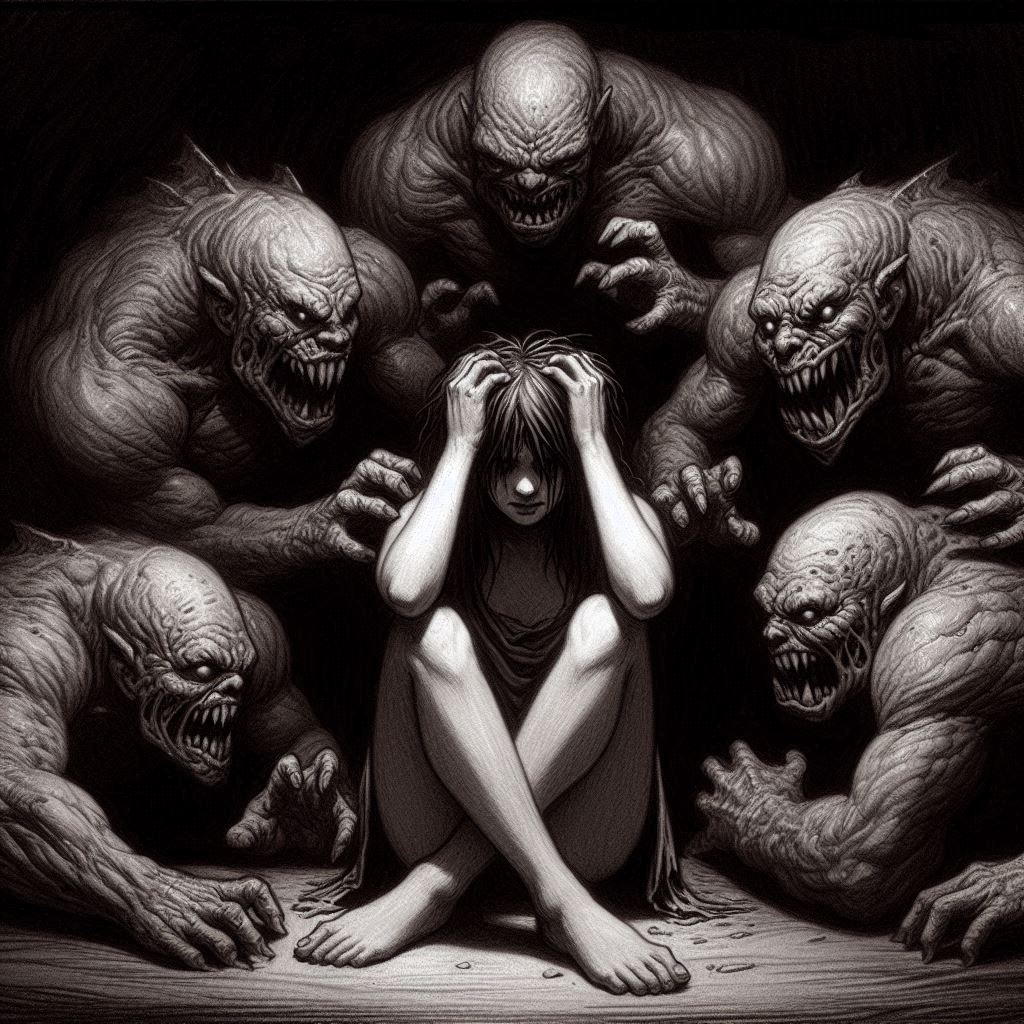
Image Description: A woman sits on the ground with her hands on her head, her head down, and her eyes closed. Surrounding her are monsters reaching out to clutch at her.
Have you ever had a panic attack?
QUEENIE:
” I have panic attacks. They creep up on me in ways where I try dismissing them until it’s too late and suddenly I can’t move, I can’t see clearly. It’s like a dark monster that slowly comes up behind me, growing bigger and bigger until I turn around and then I’m caught. Sometimes I end up dizzy and lightheaded and it’s not until later that I realize it’s because I was short of breath for hours. I have thought before that I was dying, that something was seriously wrong with me and I was dying and I would never know how or why I died. Sometimes, dying seems like a better option. I don’t generally have trouble focusing, but I won’t be able to hold onto a complete thought or sentence. It becomes impossible to speak and make any sense. And there’s no help out of it really. It’s like being tossed down a dark, bottomless hole that keeps going and there’s someone at the top saying useless things like “calm down, you’re fine,” or “looks like you’ve got this,” or “you just gotta get out of your head, everything’s fine.” So I’m stuck falling, hearing all of that, and trying to grasp at anything to pull out of it.”
TABATHA:
“When I have a panic attack, I can’t catch my breath — it’s like I’m trying to inhale through a straw that’s being pinched shut. I start swallowing air, almost gulping, desperate to calm myself but only making it worse. There’s an overwhelming urge to run — to physically remove myself from wherever I am. But if I can’t escape, everything starts to close in. I feel like I’m being crushed from all sides, like there’s not enough space for me to exist. My mind starts spiraling and blaming — I’m convinced everything is my fault, that I’ve ruined something or upset someone, that I’m stupid and wrong and should’ve known better. To protect myself, I sometimes disassociate. My heart and mind are racing and I can’t think logically — it’s all reaction. I lose track of time, but the attacks last for several minutes at least, and sometimes much longer. Afterward, I often avoid the place or situation where it happened. It adds another layer to my avoidance of confrontation because the fear of it happening again is so strong.”
DAWN:
I think I sound like a broken record, but before my meds, life was very challenging. I have had panic attacks – I’d say with different severity; but one of my most horrifying experiences was when I was in bed and I started to have these dark thoughts that I was not good enough, that life wasn’t worth living, that why am I even bothering to try anymore… and my brain was racing so fast I couldn’t even breathe. My chest and throat were tight, I had tears running down my face. In one moment, my body was trembling and I had heart palpitations – my heart felt like it was beating out of my chest, I felt I was drowning, and then suddenly I was numb and I couldn’t even move. I can’t tell you how long the episode lasted, but it drained me mentally and physically.”
SAM:
“Yes, I black out; my head starts swimming; I get tunneled vision.”
Have you ever felt gaslit or ignored by people you love or by doctors when you try to express the severity of your anxiety?
QUEENIE:
I have, a long time ago. As a result I don’t try to explain it anymore. I just do my best to work through it and hide it. One of my employees can see it and has had the grace to send me on my way and protects my dignity and privacy in those moments. My older kids know and see it and tend to be understanding when I can’t make myself take them out or show up for them the way I’d like to.
TABATHA:
“I think the person who’s dismissed my anxiety the most has been me. I’ve downplayed and questioned my own thoughts and feelings for so long — maybe because I’ve internalized the way others see things, or because I never felt like what I was going through was “bad enough” to justify support. I don’t recall a specific moment where someone flat-out said, “It’s not a big deal,” but there’s a general sense that people who haven’t experienced chronic anxiety don’t really understand the weight of it — how exhausting, irrational, and overwhelming it can be. When I first sought help, I debated whether I deserved it. I even hesitated to take medication, partly because of who I’ve always been — someone who wouldn’t even take something for a headache. I did get some judgment from friends around medication in particular, which made it harder. But I’ve been lucky, too — I went directly to a mental health provider and was supported there. Still, it’s been a process of unlearning the idea that I have to be on the edge of breaking before I can ask for help.”
DAWN:
“I don’t think I ever felt dismissed by my family or friends or doctors. An ex-boss made me once feel a situation was my fault, even though someone else had behaved inappropriately in that instance. In fact, in the events leading up to this, they made it a point to somehow state that I never do anything correctly (which let’s face it is quite literally not possible – I can’t to EVERYTHING wrong!). It was a horrid feeling and eventually became a tough place to work…Thankfully, I had the support of trusted colleagues and supervisors.(and yes, I left the job for my mental health – and it was the best decision I made). Go where you are valued and respected. Don’t let anyone dim your light because of their own insecurities.
SAM:
“Coworkers but never a doctor; coworkers have been the worst particularly other women.”
Is there anyone in your life who is especially good at grounding your or bringing you back to Earth? Describe them and how they do it.
QUEENIE:
I have one or two close friends who are good at that. It has to be well ahead of panic level when I reach out to them. I never actually tell them anything is going on with me. The magic is that I don’t have to. They can talk to me about anything and it’s a good reminder that the world isn’t falling apart. Even if it’s a 2 minute conversation, or short text exchange, just their presence with me in that moment, either on the phone, in person, or by text, will help me through a lot. Actually, the shorter the interaction the better. I don’t always have the capacity for a longer conversation, and as my anxiety rises, my capacity for conversation shrinks. The short exchange that reminds me life goes on and everything will be fine, that’s what it’s about.”
TABATHA:
“There are two groups of people in my life who help ground me the most. One is my husband — he has come to understand what supports I need and when I’m past rationality. He often reminds me to breathe and take a moment when I feel overwhelmed. The other is one of my best friends, who has a naturally calming presence and knows me well. They can often sense when something is off with me, sometimes even before I recognize it myself. They help talk me through my spiraling thoughts and reminds me that I am not defined by them.”
DAWN:
“I have a school friend who has the ability to listen – a hard trait amongst many. She has the ability to give me support and guidance without imposing anything on me. But the active listening – that has to be the part that helps me most. I feel heard, I feel seen and I am not judged.”
SAM:
“Probably my dad; he’s very logical. The logic slows me down brings me back to the reality of is this is a big or small problem and if it is big he’s there to support me.”
Do you have any coping skills that work?
QUEENIE:
“Prayer. Lots of prayer. And pacing. Pacing probably sounds like it would feed into it, but it helps me put my thoughts back in order. I actually walk a lap through my dining room and living room over and over. I probably look like I’ve lost it, but that’s what it looks like when I’m not losing it. I also keep a collection of pictures to remind me how things always work out and I have these great things in my life, and there will be more to come.”
TABATHA:
“My husband often reminds me to breathe and slow down, but silence is what helps the most. Disengaging from the situation can help me reset, though I hold myself accountable to return and finish the conversation once I’m calmer — otherwise, avoidance becomes my default. I’ve also experimented with grounding techniques like dunking my face in cold water or using ice packs on my cheeks. These work when I remember and have access to them. I once tried wearing a breathing tool necklace, which helped in theory, but wasn’t realistic for everyday use. In public places like stores, I’ve found it helpful to find a quiet corner or retreat to a bathroom stall to regroup. To reduce self-harm behaviors, one of the most effective things I do is sit on my hands the moment I feel the urge to slap myself. It forces a split-second pause, which can be enough to keep me from following through.”
DAWN:
” I have found that taking deep breaths help me in the moment. I use the CALM app and I use the SOS guided meditation in moments I feel things are a little challenging for me and anxiety is creeping up on me. It’s a 3-minute guided meditation and it helps me ground myself. Prayer helps me on some days… some days I feel very close to God and my purpose, but not always, and I’ve learnt not to beat myself up over it if there are days I don’t pray. But prayer is also a form of mindful mediation for me and it shifts my focus. Taking a minute to leave the situation/space and going for a walk also helps me and I try my best to make it a mindful walk where I take in the sights and sounds around me. Interestingly what has always helped me is washing dishes! There is something therapeutic about that and even though I have a dishwasher, somehow the sound of water, the dirt being removed, they add a sense of calmness for me.”
SAM:
“Deep breathing; letting thought it and understanding it’s just a thought then letting it go; identifying my senses where I’m at; thinking of the ocean”
How do you imagine that your life would be different if you didn’t live with chronic anxiety? If it suddenly vanished, what would your ideal life look like?
QUEENIE:
“To be able to take my kids shopping when they have events like prom or needing new sports stuff and not be limited by my anxiety! I’d have more family time, more memories with them. I’d be there, fully present, more. I’d not have to rely on others to handle things because I’ve felt trapped in my room or missing a meeting because I couldn’t leave my house that day. I’d show up more when invited out. I’d be more engaged with my family and friends – even professionally more engaged with my clients. I’d enjoy more of the world, and it’s possible the world would enjoy more of me.”
TABATHA:
“If I didn’t live with chronic anxiety, I think I’d feel less like a burden on my family and friends. I imagine I’d feel more “normal” — like I could just exist without constantly second-guessing myself. Maybe I’d have more confidence and be able to talk to people without this relentless voice in my head telling me I’m screwing everything up. I wouldn’t feel so much pressure to mask, perform, or overanalyze every social interaction.
I’d also feel much more capable at work — especially when interacting with clients. Right now, those moments feel so high-stakes that I obsess over them before, during, and long after they’re over. If anxiety weren’t constantly in the background, I think work would feel less exhausting and draining, and I’d have more energy left for the rest of my life.”
DAWN:
“OOF! See, I see this in 2 ways. First, if I didn’t have anxiety and bipolar disorder, I think maybe I’d not have missed so many opportunities that presented themselves in life to me early on. I’d have been a happier child, one that was more confident and had more self-esteem. I’d done things without always fearing the worst. I’d have lived instead of simply existing. On the other hand, because I am living with this condition, I am somewhat more empathetic towards others, I value connection, I value mental-health well-being, I choose compassion and kindness, I value growth and self-awareness. I am learning to see that life will always have sucky moments, but I can use strategies from my toolbox to cope better with them and I don’t need to drown.”
SAM:
“I would be further along in school maybe a medical doctor; more cofidence; less scarring on my face from picking.”
If you could boil it down for people to know what it feels like to live in your body with chronic anxiety, what would you say?
QUEENIE:
“I walk around everyday with an abuser in my head that isn’t me, and it’s brutal. It’s constant fear that I’ve put everyone around me at risk for something. It’s knowing that if I explain it, I’ll sound crazy, so I keep it to myself. It’s feeling like I don’t belong no matter what I do. The insecurity with it, on a scale of 0-10 ranks at a 12.
TABATHA:
“I don’t wish what I go through on anyone — truly. But I do wish people could understand how exhausting it is to live like this. Anxiety isn’t just “being worried” or “a little nervous.” It’s all-consuming. It’s in my body, my breath, my chest, my thoughts — every interaction, every task. It never fully shuts off. Even when I’m resting, part of me is still bracing. I’m constantly calculating, overanalyzing, anticipating, regretting, trying to stay ahead of some invisible threat. It’s not about being dramatic — it’s about survival. And it’s draining.”
DAWN:
“Depression and anxiety aren’t the same as having a bad day or feeling nervous. These conditions are debilitating, they quite literally stop you from functioning on some days. Be kind to everyone, you never know what they are going through… and for the love of all that is holy, please don’t tell those experiencing this: “don’t worry about it!” or “snap out of it!”
SAM:
It can be debilitating; life threatening; people can dissociate
Concluding Thoughts
As a chronically anxious with acute episodes (panic episodes), so much of what these ladies wrote resonates with my personal experience.
If you live with chronic, debilitating anxiety, I hope you also feel seen in the words above.
As you can see in their answers, the anxiety they live with is not the healthy kind that impels you to do your best on a project or gives you the butterflies before a big speech.
There were words like “vice grip”, “abuser”, and “monsters” in their descriptions.
Their anxiety is all-consuming.
It consumes them sometimes.
Sometimes it is a kind of identity.
May the women who worked on this blog with me somehow find peace that will astound them and be welcomed warmly into a world where anxiety doesn’t define them.
Resources:
The below song by Ryan Mack (“Overwhelmed”) has a great beat but also captures some of the reality of living with chronic anxiety
Anxiety and Depression Association of America offers free online support groups below
https://adaa.org/find-help/support
#MentalHealth
#MentalIllness
#Anxiety
 I'm Not The Same
Leave a comment