
For a long time, I grieved that I would not have a second child; a sibling for our older daughter. In fact, I was terrified that I would become pregnant, to the point where I asked my doctor about having a hysterectomy. I now know there are less extreme options, but this example illustrates the depth of my fear.
Why would I, the mother of a healthy little girl, fear having another child when I knew a baby was something my husband I both wanted?
It comes from an experience of incomprehensible (even to me) trauma that occurred after the birth of my first daughter.
Suffice it to say, my episode of Postpartum Psychosis (PPP) was acutely terrifying and isolating, and robbed me of critical bonding with my baby that impacted our blossoming relationship negatively.
For four years, I believed I should not have another child for fear of a repeat episode. Not only did I fear going through it again, but also being trapped in psychosis indefinitely, unable to swim my way back to reality and to my family.
Something shifted eventually, and I began to think differently. Then, as soon as my best friend sent me her positive pregnancy test, my thoughts about another pregnancy solidified. Her excitement and preparation for her first child, a daughter, made me envious for the experience. I actually started wanting to be pregnant again.
I floated the idea by my husband on a family vacation in May and he said that he thought, with the right plan and preparation, we could escape another episode. And, that even if it happened, we both knew what to expect and had in-town support we could count on.
I got my IUD removed and about 30 days later I had a positive pregnancy test. In that moment, I was thrilled, not scared. Unfortunately, it turned out to be a chemical pregnancy, which is nonviable pregnancy that shows up on a pregnancy test but, as progesterone drops, a very early miscarriage occurs. I was pretty devastated, but we kept trying, and about 7 months later, I was pregnant again. I apprehensively waited for those early blood tests, and, thankfully, all my numbers were going in the right direction.
Now, if you have read my previous posts, you may know that I have bipolar I disorder. As might be expected, I take daily psychotropic medication. You may be wondering how that impacts a pregnancy and if I discontinued my treatment while pregnant.
The answer is that I did not, and no one wanted me to. In the 6 months before my husband and I decided definitively, I talked about my psychiatrist about changing my mood stabilizer from Depakote to Lamictal. Both have been effective for me, but I had heard that Depakote could cause neural tube defects and, even though the conviction to have another baby hadn’t fully formed, I was concerned about an unplanned pregnancy. So, by the time we started trying to conceive, I had transitioned completely to Lamictal.
It turns out that many pharmacological agents are relatively safe during pregnancy. Obviously, if a birthing person can be on nothing, not even Tylenol, their baby has the greatest chance of having no health complications. But my psychiatrist and OB did a risk analysis and the antipsychotic, mood stabilizer, and antidepressant I was on were deemed to have more of a benefit to protecting my mental health during pregnancy than they were a risk to the baby. I did have to take a hefty dose of folate (more than 5 times the typical recommendation) as a protective measure. We were required to see a high-risk OB for our anatomy scan, and thankfully, there were no complications with Vida’s development.
About halfway through my pregnancy, I switched to a different OB because delivery would be nearer to our home and she had excellent patient ratings. I told her at our initial visit about my PPP episode and my concerns with the postpartum period this time around. I tried to choke back tears as I briefly described my experience and she was kind, assuring me that my medical team would wrap me in a “cocoon” of support up to and after birth.
My pregnancy progressed as planned, with minimal morning sickness, appropriate weight gain, and all the signs pointing to a healthy baby. At 36, I was considered “advanced age”, and my OB wanted to be conservative and induce me if I wasn’t already in labor by 39 weeks. We ended up pushing it back to 39 weeks and 3 days because she was on call that day and it would be more likely that she would be the one to deliver our baby, whom we hadn’t yet named.
My husband and I sat at the hospital at 10pm on a Wednesday night, waiting to get the induction started at midnight. He turned to me and asked, “Are you nervous?” I told him that I wasn’t nervous about the birth, but I was nervous about PPP happening again. He told me, “We’re going to be okay”.
As I was being prepped to start the induction, the nurse asked if we had a name. We actually had 4, none of which we could settle on. She wrote all four: Metzli, Vera, Vida, and Itzel, on the whiteboard. I was a little out of it when we decided, so, even though I swear I pointed out that Vida Itzel looked pretty together, in that order, my husband will probably claim that it was his idea.
The induction proceeded smoothly, although I wasn’t able to get any sleep. I should pause here and state very clearly that sleep was what all of this hinged on. If I was able to sleep in the postpartum period, we all thought that I could escape another PPP episode. If I had acute insomnia, it was almost certain that I would have a repeat experience.
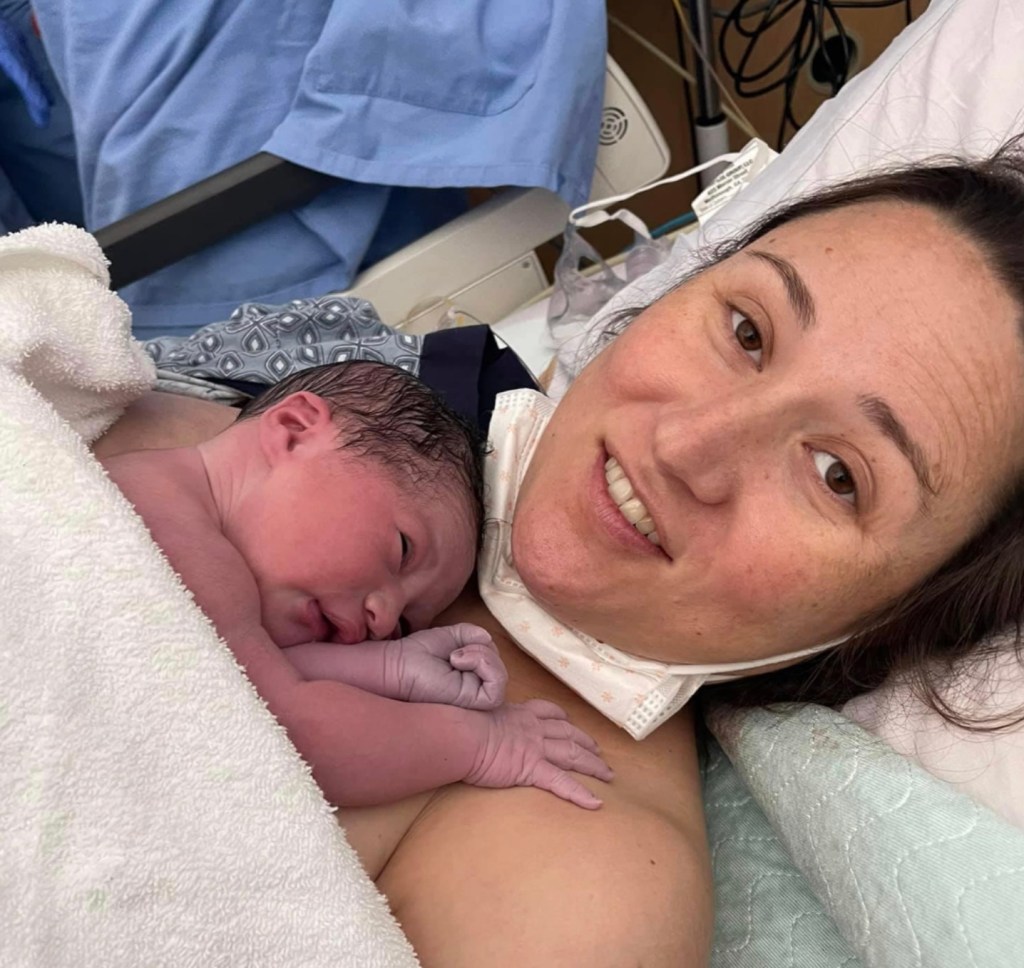
After 15 minutes of pushing. Vida Itzel was born, weighing a perfect 6 lbs and 14 oz.
After the initial nursing and skin-to-skin time, we were moved to the postpartum floor. By this time, it was nearing dinner and I hadn’t slept for almost 48 hours, which isn’t unusual for an induction. Being so exhausted, I was able to crash out for about 4 hours, until the nurse woke us up for Vida’s first bath and a nursing session.
I had been ordered to sleep in the hospital for 2 nights following birth to monitor whether I was sleeping and if my behavior appeared normal or erratic. I had to be cleared by a psychiatric nurse before we could be released.
I wasn’t able to dose off at all during the second day. Vida had had trouble latching, and one of the postpartum nurses had been adamant that we give her formula. She had downed it hungrily and slept for a long stretch. My husband suggested we give her another bottle of formula before we tried to sleep for the night. I had been part of a Facebook mother’s group during pregnancy, and once I had seen a post about the size of a newborn’s stomach and by how much the volume of those tiny bottles of newborn formula exceeded it. I began to panic that we had done irreversibly damaging to her tiny body. I began to feel vibrations of anxiety that tend to happen when I have a panic attack.
My husband fell asleep and I tossed and turned for about an hour, obsessively checking the clock and calculating how much sleep I could get until the next nursing time. I ended up going to my own bag of medication and taking a Vistiril, which is an antihistamine that helps with anxiety and can promote sleep. I then began to panic that I would be seen as “pill-popping” and that, if the staff found out, they wouldn’t release me. Being hospitalized again was my deepest fear, and I was experiencing the first signs of how deep-seeded my PTSD was.
I ended up paging the nurse, who was lovely but also not incredibly well-versed on mental health. I told her clumsily that I had chosen to take my own medication (she didn’t care) and asked if I could have anything to help me sleep. She gave me a dose of Abilify and I was able to sleep for about 3 hours.
We met with the psychiatric nurse in person and my psychiatrist virtually, and we were cleared to leave the hospital with Vida. At home, we had a first meeting with her grandparents and our daughter. We finalized sleeping and feeding arrangements, and we all tried to go to sleep, with Vida in the bassinet, and the rest of our family in the king-sized bed.
Everyone, including Vida, fell asleep. I lay there in the dark, my brain buzzing. I began to have a mildly upsetting delusion that my brain was sending me disturbing images to make me become psychotic, but that God was blocking each of them, swatting them away with His hand. I was sure it was starting again. I didn’t want to wake up my family because I was devastated that it was happening and that I would be sent immediately to the psychiatric hospital, the place I most feared.
I told my husband that I probably wouldn’t fall asleep with the eventual crying, and that I wanted to go sleep in my older daughter’s room. There, in the dark, I tried to control my breathing for almost 4 hours in the longest panic attack I have ever experienced.
Ultimately, I knew I had to tell my husband. I woke him up and told him something like, “I think it’s happening again.” Always good under pressure, he told me we would stick to the plan. He emailed my psychiatrist and tried to calm me down. 2 hours later, at around 6am, she called his cell phone.
I think my psychiatrist told him that it was probably a mix of normal postpartum insomnia, coupled with my PTSD that were causing my acute anxiety. Rather than taking a “wait-and-see” approach, she immediately prescribed me a dose of Seroquel (an antipsychotic that induces sedation) that was higher than the highest allowed level prescribed for acute schizophrenia, and 3 benzodiazepines. We all held our breath and my husband committed to keep me out of the hospital no matter the difficulties it caused him.
Some time during the first week postpartum we had a scheduled visit with my OB. She had wanted to see me as close to birth as possible, as part of the “cocoon” of support she had mentioned in pregnancy.
My blood pressure was sky-high. When she entered the room, I started babbling about how I was probably just nervous; white coat syndrome and all that. I was using what is known as “pressured” speech, which is vocalizing rapidly and with intense inflection. My doctor was immediately concerned and asked us why we hadn’t come in sooner. We explained that we had been in contact with my psychiatrist every day. She mentioned to my husband that, perhaps, it would be in everyone’s best interest if I was hospitalized.
Typing that, I just teared up.
In the moment, I cried out. I begged not to be hospitalized. I might be getting the details wrong because I was highly agitated, as well as highly medicated, but I remember apologizing and saying, “I guess I didn’t realize my PTSD was this bad”. My OB said something like, “I could sense your PTSD the very first time I met you”. She asked my husband if he was sure he could handle keeping everyone safe with me home. He said we could and we left.
There’s a long story related to collapsed pipes that led us to live out of suitcases in AirBnBs and hotels for the next six months. It’s not really important, but it adds a layer of challenge to those first 6 months postpartum that you should be aware of.
Although the massive cocktail of medication was keeping me from being psychotic, I did become moderately manic, and that mania lasted for almost 6 months.
Early in the postpartum period, it was more intense. I wrote 4-5 long emails to my psychiatrist every day, sometimes accusing my husband of postpartum rage (when really we had just had an argument). The first time I drove a car after coming home from the hospital, I ran into a traffic divider and knocked the side-view mirror off my car on the way to get donuts.
A few times I took my evening dose of meds in the morning by mistake. My nighttime meds were the heavy hitters; the cocktail had the higher dose of Seroquel and all of the benzos. The first time it happened, I was about to drive my daughters to school and the babysitter, when my husband realized I was slurring my speech and took over.
Once, I had plans to meet up with a postpartum mental health advocate and I realized I felt fuzzy. I drove to the meeting with the suspicion that I had taken the wrong dose. While I must have been lucid enough not to make a fool of myself, as I am still in contact with her, I did feel very “off” and got home to see the wrong window empty in my pill minder.
I did countless drive-up orders at Target, picking up large orders almost every day and bringing more stuff we didn’t need to our hotel rooms and AirBnBs.
During this time, I was not allowed to nurse Vida, because one of the benzos, Valium, causes sedation in infants. You may be surprised to find out that other 6 medications I was on, including the Seroquel and 2 other benzos, were deemed safe enough for nursing by our daughter’s pediatrician, my OB, and my psychiatrist. I was desperate to breastfeed Vida, as I felt that I had been robbed of the experience with my older daughter due to being hospitalized for so much of her first 6 weeks of life.
I pumped milk multiple times a day and dumped it down the sink. I wasn’t allowed to do it more than twice a day in case the pressure caused my mental health to decline. This was actually the advice of the OB, not the psychiatrist, but she was in agreement. I was told that there was no guarantee that Vida would latch after 8 weeks of having the bottle. I tried not to get my hopes up.
The big day came, and she was able to latch. We had been formula feeding for 8 weeks, so I had no reason not to combo feed, as we all knew that exclusive breastfeeding would put more burden on me for feeding and thereby possibly endanger my mental health further. After about 8 more weeks of combo feeding, my husband and I decided that my breastfeeding was more about me than Vida’s health, and we made the decision to exclusively formula-feed.
Beyond the reckless spending and long emails, the mania made me very argumentative. I said things I may have been privately thinking that I would never, in my healthy state, have said to people I respected, as well as picked fights and was frequently very verbally aggressive with my husband. At one point, he tried to talk to me and mentioned that he felt our marriage was currently at the worst it had ever been.
As we neared the 6 month mark, my mania had waned, and I started to experience a bit of depression. I no longer had the energy to write blog posts or do digital paintings, and when I wasn’t doing minimal part time work, I was sleeping. I had a phone call with my psychiatrist and she noted that I did seem depressed, but that it wasn’t entirely surprising after everything that had happened and the stress both my hormones and neurotransmitters had been under.
We eventually got to move back into our house as a family of 4. My depression lifted and I started picking up a few more hours a week with my contract job. I ended up leaving one contract job and taking another with the intention of ramping up our family business. As Vida rounded towards one year, I finally felt more like myself.
She recently turned 18 months. Vida is a hilarious, bright, spunky, joyful toddler. She is so loved by everyone who meets her, and certainly by me. Although she knows over 25 words, when she gets very excited, everything comes out as, “Mama!” I know in my bones that she loves me, and I love her right back.
In spite of the PTSD, the mania, and the rocky relational challenges, it was all worth it. Thanks to the tenacity and patience of my husband, the financial, moral, and logistical support of my parents, and the kindness and love of our friends, I didn’t have to go to the hospital.
This time, I didn’t miss the vital early days of skin-to-skin bonding with Vida. As opposed to my relationship with my older daughter, I felt like Vida’s mother immediately, and regardless of my other emotional struggles, that feeling never waned. Our bond was cemented immediately and was never interrupted.
I tell this story because the telling helps flush out the residual pain and shame.
I also tell it to impart the importance of preparation and support.
We rolled a lot of dice and took a lot of chances in expanding our family. However, we also did significant research and connected with the proper medical staff in preparation for the postpartum period. The medications I was on were planned for and established at stable levels 6 months before we started trying to conceive. We had my parents just 20 minutes away, and they were willing to watch the girls or stay with us so I could sleep while my husband was out of town. My psychiatrist was available by email and she was incredibly responsive, getting back to us with medication adjustments or advice, typically within 12 hours.
This may be just a deeper insight into my life for some readers, or a bit of information about what the postpartum period is like for a mother with bipolar disorder.
But, if you are someone who is at high-risk for a perinatal mood disorder and may potentially become a mother, I want to say two things to you.
1.) You NEED to be fully prepared for the postpartum period. That means working with a psychiatrist while you are still pregnant, even if you do not take medication during your pregnancy. In the event that you have significant mental health issues postpartum, it will be much easier to get help if you are already tapped into psychiatric care. It would also be helpful to get connected with a counselor before you give birth in the event that a perinatal mood disorder can be treated through therapy alone, or in conjunction with psychiatric care.
2.) Just because you had a negative, scary, or traumatic experience with your first child does not mean you can’t have more children IF you prepare sufficiently AND have significant support in the form of a partner, family, or close friends. I spent 4 years grieving a lost sibling for my daughter, but, in spite of a difficult year, I now have the joy of two children.
If you are experiencing challenges surrounding your mental health in the first year after giving birth, visit Postpartum Support International’s website for information about various perinatal mood disorders, resources, and connections to providers and peer mentors.
 I'm Not The Same
Leave a comment